
How do sensory cortical dynamics contribute to distractor attenuation?
When performing goal-directed tasks, one major challenge is ignoring distracting stimuli and staying focused.
We have developed a novel cross-species Distractor task that can be implemented in mice and humans to study successful distractor attenuation
in neurotypical brains and deficits that lead to distractor susceptibility in FXS and ASD brains.
Mouse performing a visual discrimination task in the presence of auditory distractors – Distractor Task
Neural Mechanisms of Distractor Attenuation
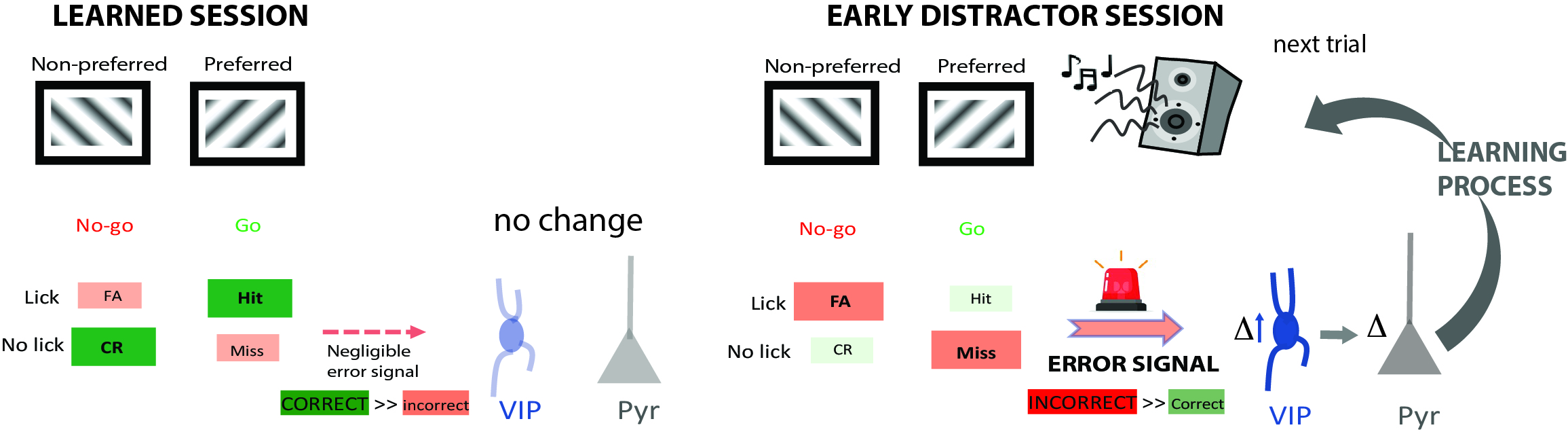
Dysfunction of VIP cells increases error rates and distractor susceptibility in Fmr1 KO mice (the primary Fragile X model).
Adapted from Rahmatullah N. et al., 2023.
https://doi.org/10.1523/JNEUROSCI.0571-23.2023
Top-down modulation of V1 during distractor attenuation
Input from Anterior Cingulate Cortex (ACC) to V1 provides attentional modulation and error monitoring during goal-driven tasks.
Using calcium imaging, we are examining ACC to V1 terminal dynamics during distractor attenuation.
(Funded by the Hellman Foundation and BBRF).
Calcium imaging of ACC projections to V1 during distractor modulation